

Canada’s healthcare system is often recognized globally for its accessibility and equity—but how does universal health care in Canada actually work?
Whether you’re a healthcare professional, student, or employer, understanding healthcare in Canada is essential to navigating opportunities in the industry—and platforms like Caring Support play a growing role in supporting this ecosystem.
At its core, Canada universal health care—often referred to as “Medicare”—is a publicly funded system that ensures residents have access to medically necessary healthcare services regardless of their income.
According to the Government of Canada’s overview of the Canada health care system, this model is funded primarily through taxes, allowing eligible residents to access essential medical services without paying out-of-pocket at the point of care.
This approach is built on a simple but powerful principle: access to healthcare should be based on need, not the ability to pay.
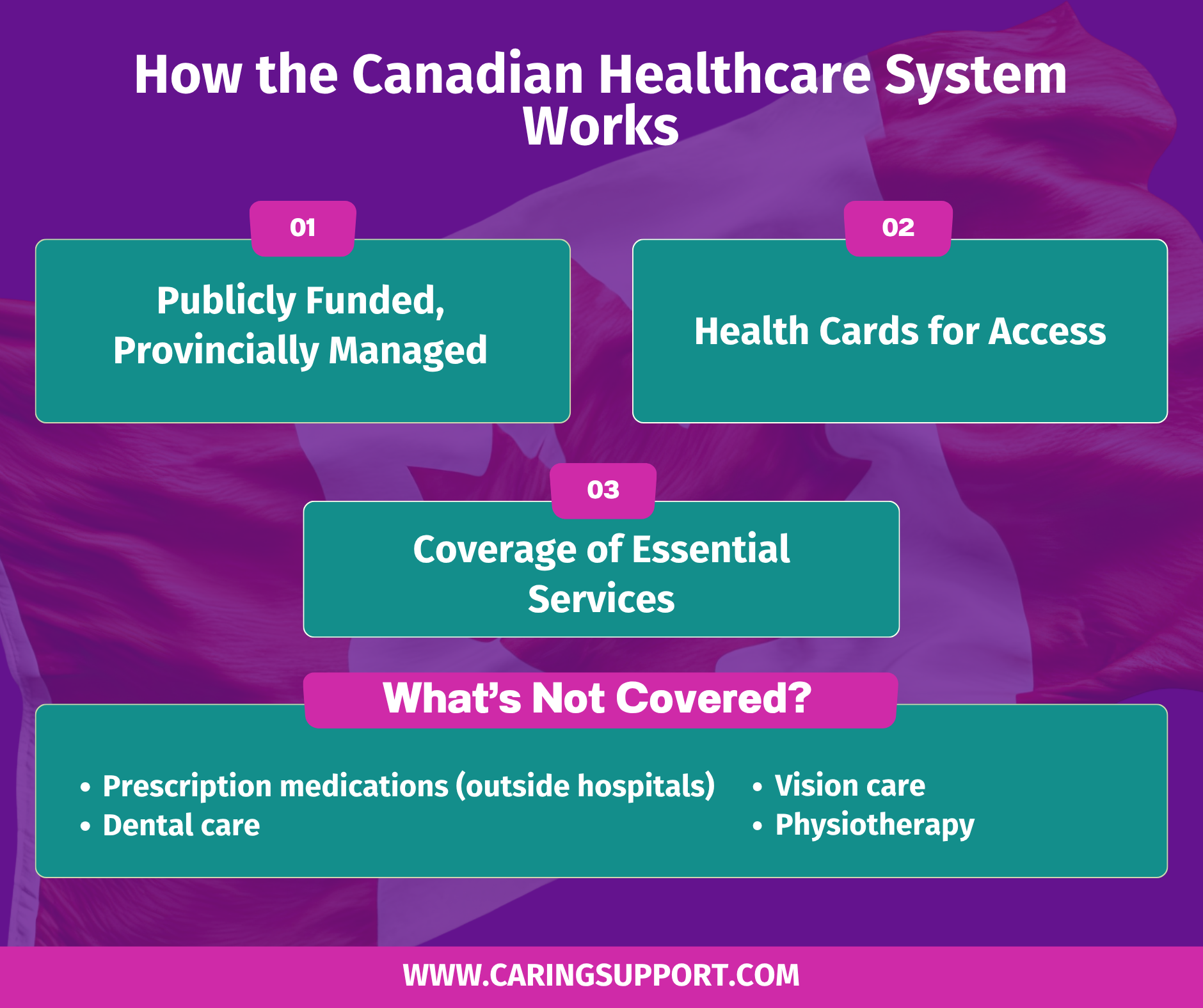
Canada does not have a single national healthcare system. Instead, it operates through a network of provincial and territorial health insurance plans.
Here’s how it works:
Each province and territory manages its own healthcare plan, while adhering to federal standards outlined in the Canada Health Act and provincial healthcare systems overview.
Residents receive a health card, which they present when accessing services, as explained in this guide on how Canada’s universal healthcare system works for residents.
Most plans cover:
These are considered “medically necessary” services under public healthcare coverage in Canada, meaning they are typically free at the point of care.
While the system is comprehensive, it doesn’t cover everything.
Services that are often excluded or only partially covered include:
As outlined in resources on healthcare coverage gaps in Canada, many Canadians rely on private insurance or employer benefits to cover these additional services.
All citizens and permanent residents are eligible for public healthcare coverage.
Patients don’t pay when they visit a doctor or hospital for insured services.
Coverage follows residents across provinces, ensuring continuity of care.
Healthcare is delivered through a publicly funded system rather than a private, profit-driven model.
These principles make Canada’s system one of the most recognized universal healthcare frameworks globally, often highlighted in international healthcare system comparisons.
Despite its strengths, Canada’s healthcare system faces several challenges.
Some of the most common issues include:
Insights from healthcare system performance reports in Canada suggest that addressing these challenges requires better workforce planning, improved recruitment, and stronger system coordination.
This is where platforms like Caring Support are becoming increasingly important.
As Canada continues to experience healthcare staffing shortages, the need for efficient recruitment and workforce development has never been greater.
Caring Support bridges this gap by connecting healthcare professionals, employers, and educational institutions—all in one place.
For example, employers looking to address staffing shortages can benefit from strategies outlined in this guide on filling critical roles in Canadian healthcare, while candidates can explore how AI-powered job matching improves hiring outcomes.
The platform also plays a key role in addressing systemic barriers, as highlighted in this article on how Caring Support reduces barriers across the healthcare industry.
As the demand for healthcare services grows, so does the need for a well-prepared workforce.
Students and new graduates can better understand industry expectations by exploring insights from preparing Canada’s healthcare workforce for 2026.
At the same time, evolving trends in hiring and workforce needs are shaping the future of healthcare, as discussed in healthcare search trends in 2026.
By aligning talent with opportunity, Caring Support helps strengthen the very foundation of Canada’s universal healthcare system—its people.

Not entirely. While essential services are covered, additional services like dental and prescription drugs may require private insurance.
Citizens and permanent residents who meet provincial residency requirements are eligible.
It’s a shared system: federally guided, but provincially managed and delivered.
High demand and limited resources can lead to delays for non-emergency procedures.
Caring Support connects candidates with employers, simplifies job searching, and improves hiring through smart matching tools.
We'll keep you updated on all new application updates and features!