

The way Canadians approach education is evolving — and healthcare professionals are no exception. Traditional degrees have long been the gold standard for career advancement, but microcredentials are quickly emerging as a powerful alternative. With the healthcare industry experiencing rapid technological and procedural changes, learning that is fast, practical, and directly aligned with workforce needs is more valuable than ever.
This article explores why microcredentials are gaining traction, how they compare to degrees, and why the Caring Support Academy is leading the way in healthcare-focused microlearning.
Microcredentials are short, focused learning programs designed to teach specific skills, knowledge, or competencies. Unlike full degrees, which can take years to complete, microcredentials allow learners to gain career-relevant expertise in weeks or months.
In healthcare, this can include certifications in dementia care, financial wellness for healthcare workers, professional home care skills, or caregiver support programs. These courses are designed to deliver practical, actionable knowledge, helping learners become job-ready faster.
Learn more about why microcredentials are the fastest way to boost your healthcare career in Canada.
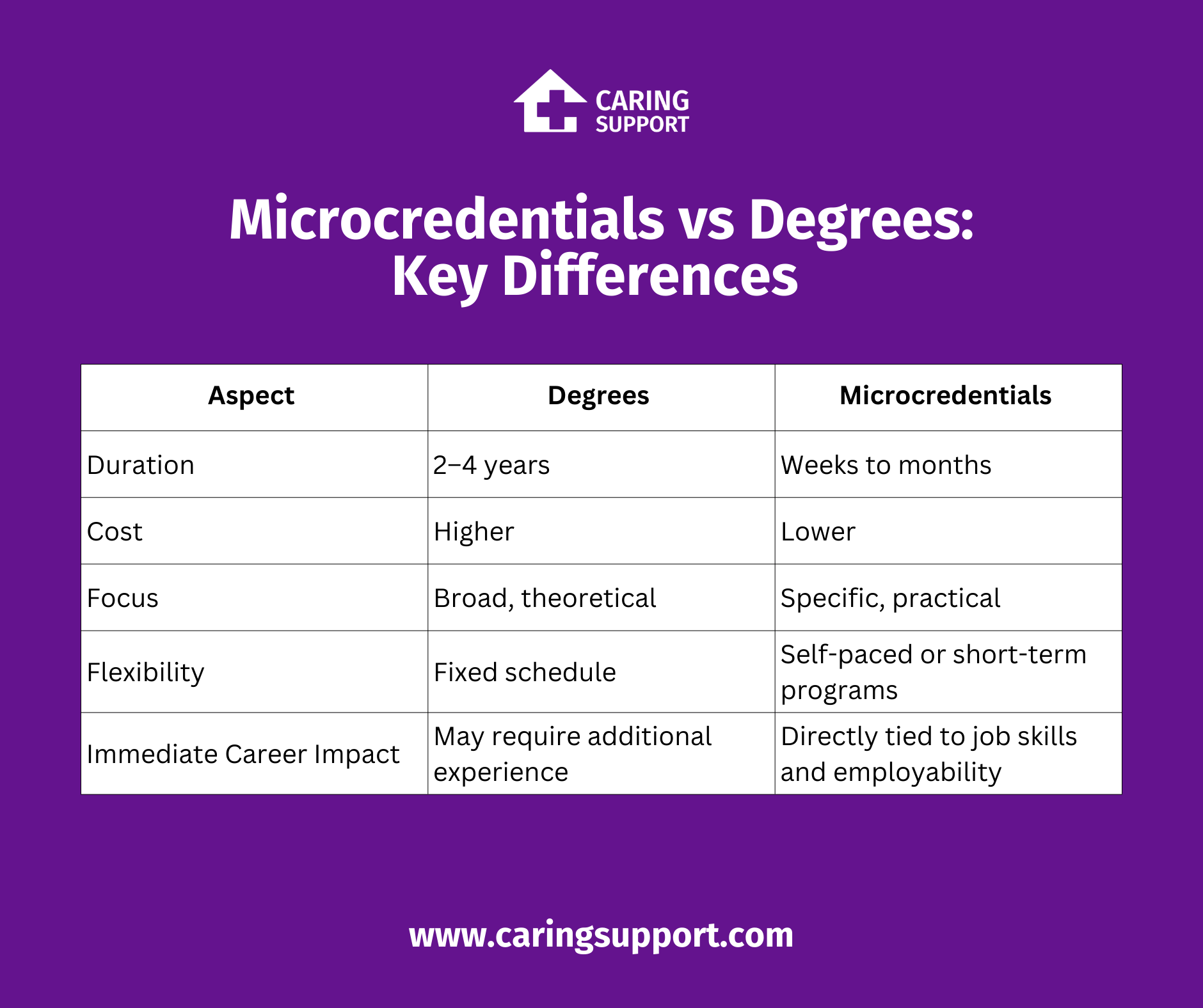
For healthcare students and professionals, microcredentials provide immediate career benefits, often aligning with employer needs and emerging industry trends.
Check out our list of top 5 micro-credential certificates in Canada to advance your career.
Learn about boosting your healthcare career before 2026 with top microcredential courses in Canada.
Traditional degrees provide comprehensive knowledge, professional recognition, and foundational understanding. They are critical for regulated roles like nursing or allied health professions that require specific licensing.
However, for learners seeking rapid upskilling, practical knowledge, or career-specific certifications, microcredentials often deliver faster ROI. By complementing a degree with microcredentials, healthcare professionals can stay competitive and demonstrate continuous learning.
Explore how microcredentials can help you land your dream healthcare job in Canada before 2026.
The Caring Support Academy offers short, stackable, industry-relevant courses designed specifically for healthcare professionals. Features include:
The Academy’s microcredentials are particularly valuable for new graduates or professionals aiming to enhance their employability, aligning with the traits employers look for when hiring, as explored in top traits to look for when hiring new grads in healthcare.
For a detailed roadmap, see why microcredentials are the fastest way to boost your healthcare career.
Yes, microcredentials offered by reputable platforms like Caring Support Academy are increasingly recognized as valuable skills by employers, especially for specialized or practical roles.
Not entirely. While microcredentials are excellent for skills development and career advancement, degrees remain necessary for regulated roles such as nursing or allied health professions.
Most microcredentials are designed to be completed in weeks to a few months, depending on course intensity and learner availability.
Absolutely. Microcredentials are job-focused, teaching skills that align with employer needs, which can accelerate hiring for both students and working professionals.
Yes. Many microcredentials can be combined to form advanced certifications or even contribute toward degree pathways, offering flexible career progression.
We'll keep you updated on all new application updates and features!