
The landscape of healthcare jobs in Canada is changing faster than ever. Hospitals, clinics, and healthcare organizations are competing for qualified nurses, personal support workers (PSWs), allied health professionals, and specialized clinicians. Traditional recruitment methods are struggling to keep up, and employers are realizing that AI, data, and technology-driven hiring solutions are no longer optional—they are essential.
In this article, we explore how Canadian healthcare employers can leverage AI and data to transform recruitment, attract top talent, and prepare their organizations for the challenges of 2026.
Canada’s healthcare system is facing a significant workforce shortage. According to Health Canada, staffing gaps affect patient care, increase operational stress, and create burnout among existing staff.
Traditional recruitment strategies—posting jobs on bulletin boards or generic job boards—are no longer sufficient. Top candidates are selective, have high expectations for workplace culture, and often bypass conventional hiring channels. Employers need smarter, faster, and more targeted recruitment strategies to compete.
AI-powered platforms are revolutionizing the way healthcare organizations hire. From resume parsing to predictive analytics, AI can identify candidates who not only meet the qualifications but also align with organizational culture and long-term retention goals.
For example, Caring Support’s AI-powered job matching connects employers to candidates based on skills, experience, and preferences, significantly reducing time-to-hire and improving quality of matches. AI-driven recruitment ensures that critical roles are filled quickly and efficiently, freeing HR teams to focus on strategy rather than manual screening.
Data analytics allows employers to make evidence-based hiring decisions. By analyzing historical hiring trends, turnover rates, and candidate engagement patterns, organizations can identify gaps, predict staffing needs, and optimize recruitment pipelines.
For hospitals and clinics, this means fewer open positions, reduced overtime costs, and better patient outcomes. Learn how technology supports these goals in Caring Support’s Technology and Mission.
Top healthcare professionals today are looking for engaging recruitment experiences rather than just applying to jobs. AI platforms allow organizations to:
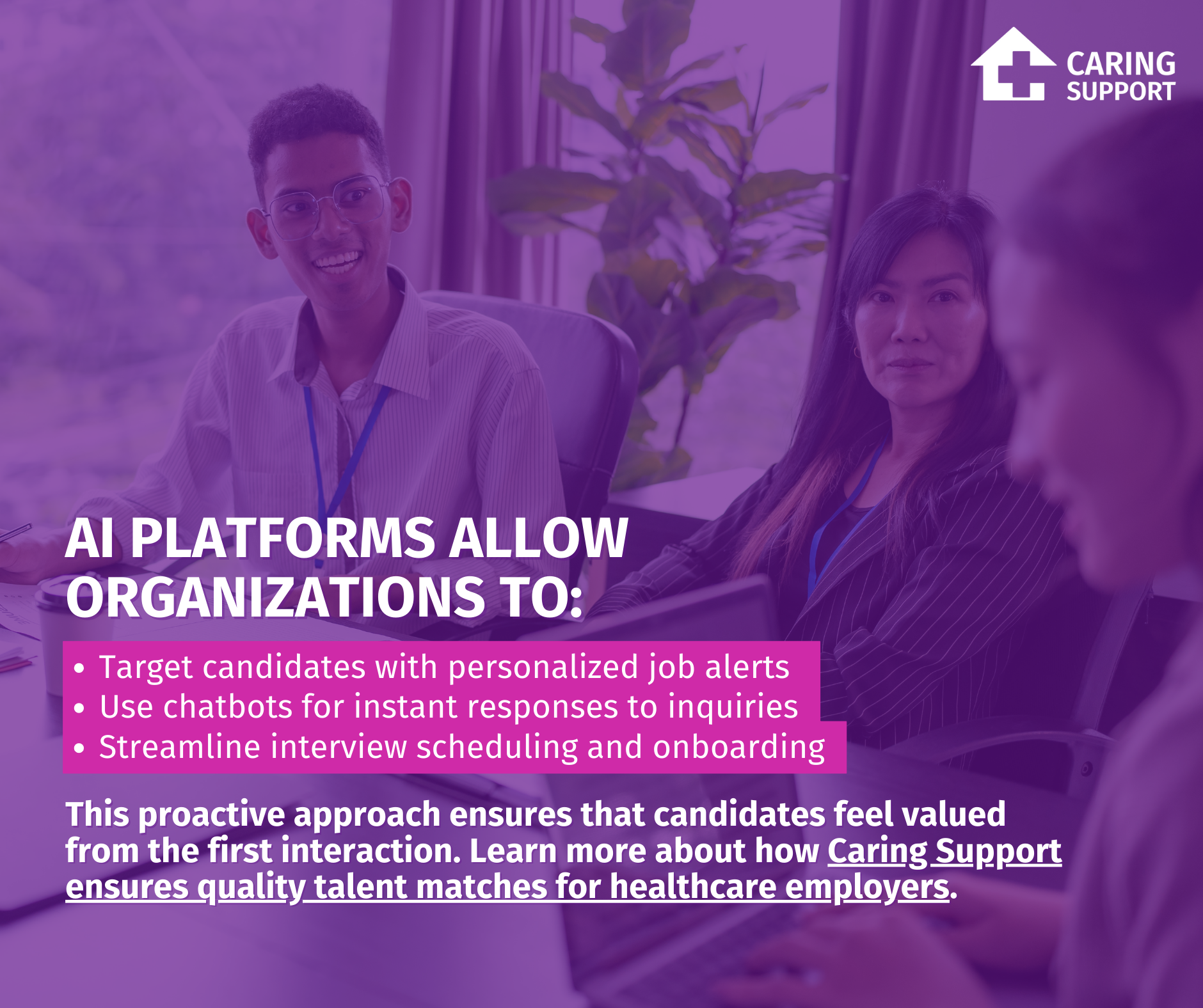
This proactive approach ensures that candidates feel valued from the first interaction. Learn more about how Caring Support ensures quality talent matches for healthcare employers.
Data and AI are not just about efficiency—they are also tools for employer branding. Organizations that highlight mentorship programs, continuing education, wellness initiatives, and supportive workplace culture attract top candidates.
Healthcare employers can leverage platforms like Caring Support’s Marketplace to showcase their brand to professionals across Canada. This approach helps differentiate your organization in a competitive market.
Predictive analytics enables healthcare employers to anticipate staffing shortages and proactively recruit candidates before critical roles are vacant. Using historical data and AI models, organizations can forecast:
By planning ahead, employers can maintain operational efficiency and improve patient care, while also reducing recruitment costs and stress on HR teams.
Hiring is only half the battle—retention is equally critical. AI-driven platforms can identify employee satisfaction indicators and potential burnout risks. This allows HR teams to implement retention strategies such as mentorship programs, career development opportunities, and wellness initiatives.
Hospitals and healthcare organizations that invest in technology-driven hiring and retention strategies create a cycle of talent stability that benefits staff and patients alike.
Integrating AI and data tools with existing HR systems and clinical teams is key. Seamless workflows between hiring platforms, payroll, scheduling, and training systems allow for:
This integration ensures that technology enhances, rather than disrupts, healthcare operations. For practical examples, see Filling Critical Roles: Top Strategies for Canadian Healthcare Employers.
To thrive in Canada’s evolving healthcare landscape, employers should:
By taking these steps, organizations position themselves as forward-thinking employers, ready to navigate the challenges of 2026 and beyond.
AI streamlines candidate matching, predicts workforce needs, and reduces time-to-hire while improving quality of hires.
Platforms with AI-powered matching, applicant tracking, predictive analytics, and candidate engagement tools are highly effective.
Retention improves with mentorship, professional development, wellness initiatives, and AI monitoring for employee satisfaction.
Top candidates prioritize supportive work culture, career growth, and organizational reputation when choosing employers.
By ensuring HR, clinical, and scheduling systems are connected, AI can enhance efficiency while minimizing disruptions.
The future of hiring in Canadian healthcare is data-driven, AI-enabled, and candidate-focused. Employers that embrace these tools gain a competitive advantage in attracting and retaining top talent, improving operational efficiency, and delivering better patient care.
Canada’s healthcare system is evolving—and the organizations that evolve their hiring practices with it will thrive in 2026 and beyond.

We'll keep you updated on all new application updates and features!